Almost everyone comes to Udawalawe for the elephants. Most of them leave not realising that the birdlife here is among the richest of any national park in Sri Lanka.
This is not a complaint. The elephants deserve the attention they get. But if you are spending four to five hours inside the park, there is a whole layer of wildlife happening at every level, from the treetops to the water's edge, that most people drive past without looking up.
Here is what is there if you do look.
The raptors
Eagles are the most visible group in Udawalawe. The open grassland and reservoir give them clear hunting territory, and they are almost constantly in the air or perched on high branches.
The White-bellied Sea Eagle is one of the most impressive. Large, with striking white undersides and a pale grey back, it hunts over the reservoir and can be seen hovering or diving for fish. Pairs often nest in large trees near the water.
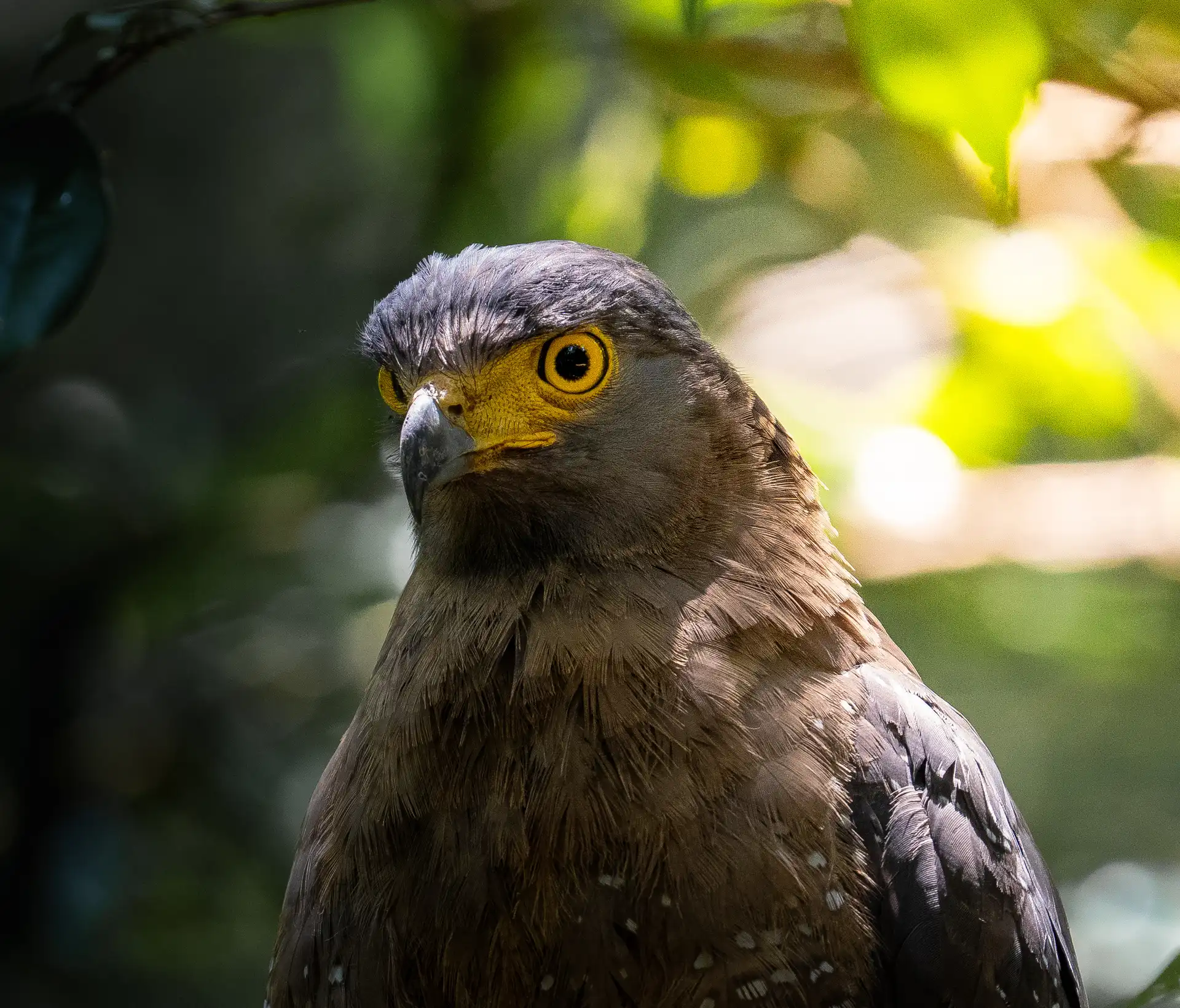
The Crested Serpent Eagle is heard as often as it is seen: a distinctive loud call that echoes across the forest edges. When you find one perched, usually on a medium-height branch, it stares back with a striking yellow and black crest raised above its face.
Changeable Hawk-Eagles, Grey-headed Fish Eagles, and Brahminy Kites are all regular sightings. In the open grasslands, watch for Booted Eagles and smaller kestrels hunting close to the ground.
The wetland birds
The reservoir edge and the wetlands around the smaller lakes are where the variety concentrates.
Painted Storks are among the most visually striking birds in the park. Large, with bright pink wing tips and a heavy bill, they often stand in shallow water in groups, sweeping their beaks through the water to catch fish. Flocks of them on the reservoir edge in morning light are genuinely worth stopping for.
Pelicans are a regular sighting, both Spot-billed and Great White, often in groups on the open water or in trees near the shore. When a group of pelicans rises from the reservoir in unison, it is one of those moments that makes you realise you are in a genuinely wild place.
Purple Herons, Grey Herons, and Night Herons are common around the water. Spoonbills and Black-necked Storks appear less frequently but are present. The Pheasant-tailed Jacana, a small bird that walks across lily pads on improbably long toes, is one of the more charming things you can find in the shallower pools.
The small birds
Green Bee-eaters are everywhere. They perch on low branches and fence wires, flash brilliantly green as they dart after insects, and return to the same perch again and again. If you are in Udawalawe and you see a small bird the colour of an emerald catching insects in the air, that is almost certainly what you are looking at.
The Asian Paradise Flycatcher is less common but memorable when you find it. The male has a long trailing tail, either pure white or a deep rufous orange depending on its colour phase, that flows behind it as it moves through the forest understory. Spotting one usually produces a genuine reaction from whoever is in the jeep.
Sri Lanka Junglefowl, the country's national bird, are regulars along the forest edges. The males have a spectacular plumage with deep orange and dark green colouring. Watching one step carefully through the undergrowth early in the morning, before the heat builds, is a good reminder that even the everyday wildlife in Udawalawe is extraordinary.
How to actually see them
Binoculars make an enormous difference. Many birds are visible to the naked eye but reveal themselves properly only with magnification. If your safari operator can provide them, use them. If not, bringing your own is worthwhile.
Slowing down helps more than almost anything. The birds at the roadside are often visible only for a moment before the jeep passes and they flush. A driver who is willing to stop, watch, and wait transforms the birdwatching experience completely.
Early morning is best, as it is for most wildlife. The first hour in the park, when the light is good and the heat has not built, is when the most species are active and visible.
You do not have to be a committed birdwatcher to find this worthwhile. You just have to look up occasionally. The park rewards that habit more than most people expect.