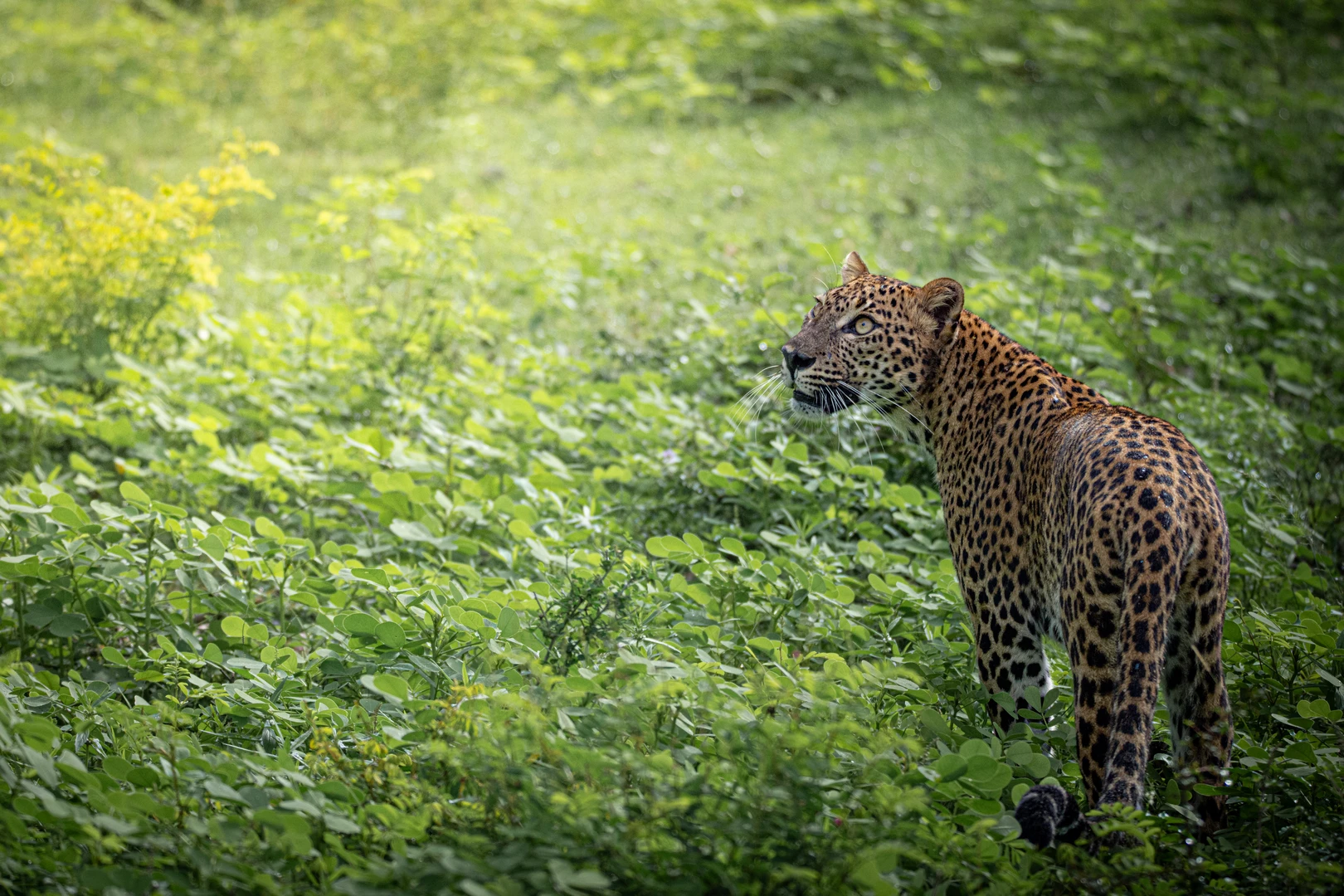
Yala genuinely has one of the highest leopard densities in the world relative to its area. That is not marketing. It is a real ecological fact.
But there is a significant gap between the densities in the research papers and what you will actually experience on a safari day. I want to close that gap honestly.
What the density actually means
When researchers say Yala has a high leopard density, they are measuring the number of individual leopards across a defined area. Estimates vary, but somewhere in the range of 15 to 35 leopards in Block 1 alone is commonly cited.
That sounds like a lot until you consider that Block 1 covers around 140 square kilometres of forest, grassland, and rocky terrain. The leopards have enormous home ranges. They are secretive by nature. They move mostly at dawn and dusk. They spend most of the day resting in dense vegetation or on rocky outcrops where they are invisible from a jeep track.
High density means your statistical chance of an encounter is better here than almost anywhere else in Asia. It does not mean they are waiting by the roadside.
What affects your chances
Time of day matters enormously. The window between 6am and 8am, the first two hours after the gates open, is when leopards are most active. They have been moving during the night and are often still out as the day brightens. By 9am most have found shade. By midday a leopard sighting in Yala is genuinely unusual.
This is why I am always direct with guests about morning starts. If you want the best chance at a leopard, you need to be at the gate when it opens at 6am, and you need to be moving through the park in the first hour with a driver who knows the current patterns.
Season also matters. The dry season from May to September concentrates leopards around remaining water sources, making their movements more predictable. The wet season does not make sightings impossible, but the dense vegetation and dispersed water sources make them less likely.
Block choice matters. Block 1 has the highest confirmed density and the most regular sightings. Block 5 has lower but real chances. Block 6 has occasional sightings but should not be the primary reason for choosing it.
The honest probability
Nobody can give you an accurate percentage, and anyone who does is guessing. We don't quote odds on our safaris — we don't think we have enough reliable data from our own operations to make that kind of promise honestly.
What I can say is this: in Block 1 during dry season, with an experienced driver, entering at dawn, your chances over a half-day safari are genuinely meaningful. Real enough to justify coming specifically for leopards. Not certain. Not even close to certain. But real.
In Block 5 under similar conditions: lower than Block 1, but still real. Leopard sightings happen in Block 5. Not every day, but they happen.
Over multiple safaris, your cumulative chances improve. Guests who stay two or three days and do multiple mornings in Yala often see a leopard. Guests who do one half-day may not.
What a sighting actually looks like
This is worth knowing before you go.
Most leopard sightings in Yala are brief. A leopard crossing a track, visible for five to fifteen seconds before disappearing into the bush. A leopard resting on a rock at distance, staying still for some time and then moving away. These are real sightings, but they are often less dramatic in person than the photographs suggest.
The long, close, relaxed sightings where a leopard sits in full view for thirty minutes while jeeps gather around: these happen, but they are not typical. When they do happen, Block 1 becomes extremely crowded very fast. Whether that is worth it depends on you.
How to approach it
The best advice I have is simple. Go with a genuine intention to see a leopard, but do not make it the condition of a good safari.
Every day I spend inside Yala is interesting, with or without a leopard. The birds alone are extraordinary. The crocodiles, the deer, the landscape as the light changes through the morning. These things do not require a leopard to be worthwhile.
The guests who see the best things in Yala are the ones who are genuinely open to whatever the forest decides to show them.
Leopards happen to those guests too. But they are not disappointed when they do not.
If you are planning a safari in Yala Block 5 specifically, our dedicated site Yala Ethical Safari has full details on how we run these trips.